Nuclear Magnetic Resonance (NMR) Spectrum Prediction
NMR is one of the most widely used tools in the organic chemistry lab, but computationally predicting a spectrum has traditionally been slow. The conventional approach involving conformer searching, DFT optimization of every conformer, per-conformer DFT shielding calculations, and Boltzmann-averaging and empirically scaling the results can take hours per molecule and days or weeks for a full study.
Rowan's NMR workflow replaces the DFT step with MagNET, an equivariant graph-transformer model, developed with Eugene Kwan and co-workers at Merck, the Coley and Smidt groups at MIT, the Liu group at Harvard, the Paton group at Colorado State, and others. MagNET was trained on millions of DFT-computed isotropic shieldings and predicts them directly from a molecule's 3D geometry, skipping the DFT calculation entirely while matching or exceeding typical DFT accuracy and running orders of magnitude faster.
Predicting NMR with Rowan
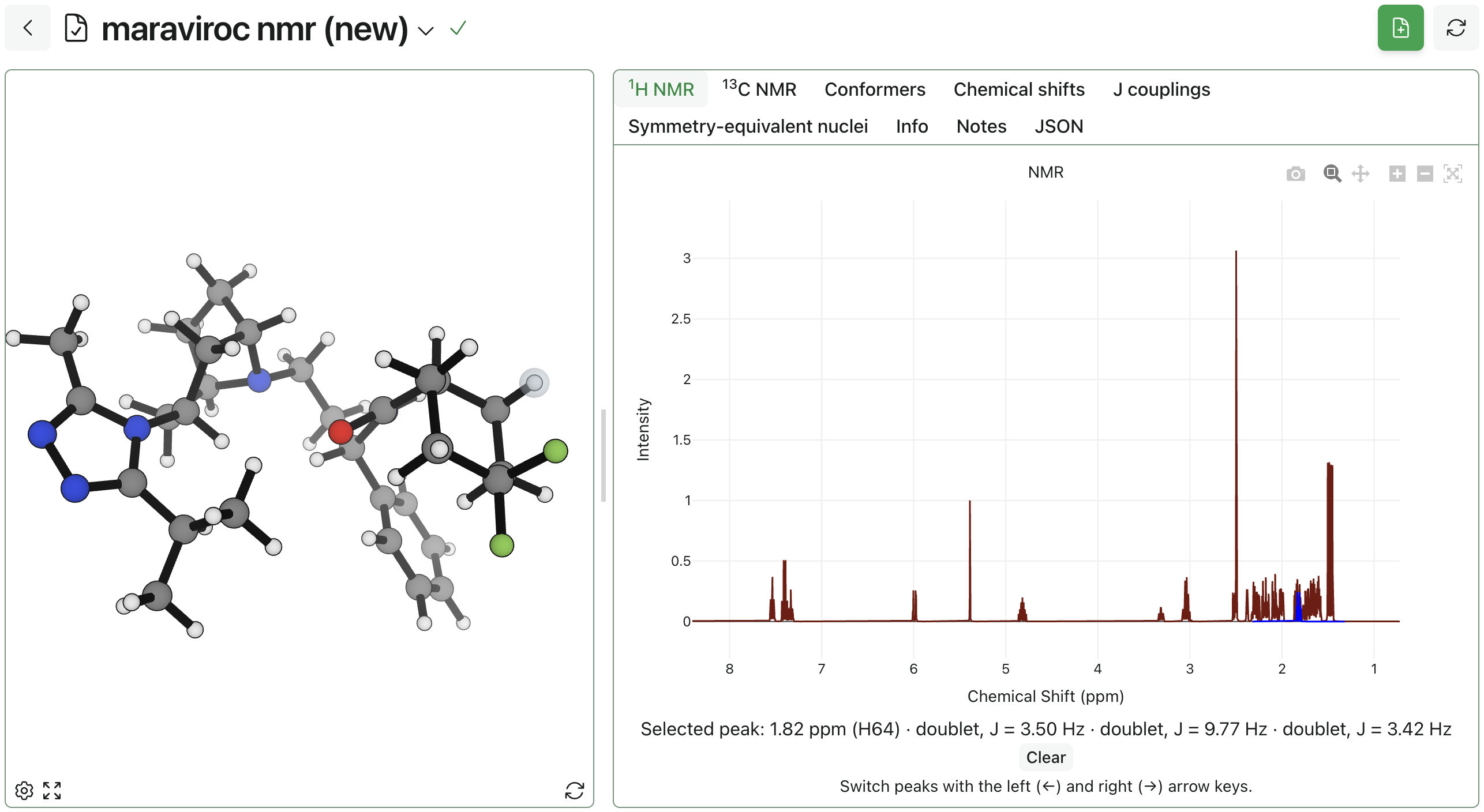
Because prediction now takes minutes instead of hours or days, NMR prediction becomes something you reach for at every step of a structure's characterization, not just as a last resort. Both 1H and 13C spectra are supported, and Rowan's interactive viewer lets you click a peak to see which atoms it corresponds to. This makes it easy to:
- Compare predicted spectra for candidate structures against experimental data to confirm—or rule out—a proposed product.
- Use CP3 scoring to assign relative stereochemistry without running DFT.
- Predict how a spectrum will change in different solvents to help resolve overlapping peaks before ever touching the NMR instrument.
Professor Michel Gravel from the University of Saskatchewan, one of our early NMR users, writes:
The NMR workflow in Rowan is very helpful for my research group. We routinely use it to ascertain the products of a reaction, to assign relative configuration, and to elucidate unknown structures. In our experience, the MAE is on par with the most accurate DFT methods. The workflow is so seamless and the interface so user-friendly that we have adopted it to complement our undergraduate lab experiments.
Using NMR Prediction to Help AI Agents
Because MagNET is fast enough to call over and over, it's a natural tool to hand to an AI agent working on structure-elucidation problems. We tested this directly: giving an LLM agent repeated access to Rowan's NMR-prediction tool while it worked through difficult 13C structure-elucidation problems substantially improved its success rate, letting it reason for longer and rule out incorrect candidate structures along the way. Read the full writeup on our blog.
API
NMR predictions can also be run via Rowan's Python API, making it easy to batch predictions or wire NMR simulation into an agentic workflow:
import rowan

folder = rowan.get_folder("examples")

workflow = rowan.submit_nmr_workflow(
    rowan.Molecule.from_smiles("O[C@H]1[C@H](C(C)C)CC[C@@H](C)C1"),
    name="menthol NMR",
    folder=folder,
)

print(f"View nmr workflow privately at: https://labs.rowansci.com/nmr/{workflow.uuid}")

result = workflow.result()

# print hydrogen peaks (atomic number 1 = hydrogen)
for peak in result.predicted_peaks[1]:
    print(peak)
For more examples, see our example scripts on GitHub.
Ready to try it out? Create a free Rowan account and predict your first spectrum in minutes.