Automating Organic Synthesis: A Conversation With Daniil Boiko and Andrei Tyrin from onepot
by Corin Wagen · Dec 5, 2025
While designing and simulating chemical species can be powerful, all molecules intended for real-world applications must ultimately be synthesized in a laboratory. Unlike oligonucleotides or proteins, which can typically be synthesized in a fully automated fashion, small molecules require bespoke syntheses. Most of this synthesis is still performed by human scientists, making it slow and expensive; Abhishaike Mahajan has written about how this "synthesis bottleneck" limits the impact of generative small-molecule chemistry.
One startup attempting to challenge this paradigm is onepot. Founded by Daniil Boiko and Andrey Tyrin, OnePot recently announced a $13M seed round backed by Fifty Years, Khosla, Jeff Dean, and others. I spoke with Andrey and Daniil to try and understand what OnePot's doing differently, where they see opportunities and challenges ahead, and what they're excited about for the future.
Corin Wagen: You're onepot and you guys just raised $13 million to automate organic synthesis. Would you introduce yourselves and tell us a little about what you do and what your vision for onepot is?
Daniil Boiko: I'm Daniil. I was initially an organic chemist by training. I was studying reaction mechanisms and basically learning why reactions do what they do. Then I saw huge potential in applying ML for chemistry. I published a bunch of papers in automating analysis of mass spec [mass spectrometry] and electron microscopy data.
I then moved to the US to do a PhD working with Gabe Gomes on many different things: molecular representation learning for graph neural networks, catalyst discovery, and the first example of using LLMs to automate science. I then moved to San Francisco and worked at a startup, where I was the first ML hire and was building models to estimate drug toxicity, specifically liver toxicity and risk of drug-induced liver injury.
Throughout all this time I saw how complex this problem is. People avoid very interesting molecules because of synthesis. People could discover much more interesting molecules if synthesis was much easier. So it made a lot of sense to actually try to solve this problem. So I teamed up with Andrei and started OnePot.
Andrei Tyrin: I'm Andrey. I did a lot of chemistry competitions in high school and was really excited about the intersection of chemistry and computer science. I did my CS undergrad at MIT where I worked on different machine learning projects for drug discovery. I worked at Schrödinger, where I was training generative models for molecular design, and then Genesis Therapeutics, where I was working on protein–ligand folding models.
And I had a similar experience to what Daniil said: that there are all this advancements in machine learning and computational methods for drug discovery, but the compounds still need to be made and the way that it's done right now is really the same way it was done hundreds of years ago in many ways. So this is a very exciting problem and a very important problem and that's what we work on at onepot.
Corin: As you say, many people have made organic molecules before. There are plenty of businesses that essentially exist as synthesis-as-a-service or attempting to take a crack at the synthesis problem: I could name startups, I can name existing companies. What makes onepot different? What's the new thing you guys can do that hasn't yet been done successfully?
Daniil: It's a great question and Andrei is going to kill me right now, but one of the good analogies here is actually to compare this to restaurants. It makes sense to try to automate what restaurants do. You could imagine the types of companies doing automation of restaurants: some companies build robots to make pizzas. The robots have robot arms: they place salami and all the different foods there. Most of the companies are like that.
There is also a wave of companies that says, "Well, all right, so we have a robot or maybe we have a human who does it, but maybe we can make pizza-making much more efficient. Let's try to predict what's the best way of placing food so customers are happier and predict how we can streamline this process."
So a lot of companies work in this space. Pretty much any of the companies we would name probably fall into these groups one way or another. But we thought about a slightly different thing. We thought, all right, you can get these robots that will do pizzas. You can do this. It's fine.
But what about other dishes? How do you automate the process of adding new dishes to the menu? How do you automate this entire process? And it's basically what onepot does except dish classes are reactions: pizza, salads, and all the different stuff. So all our competitors focus a lot on—and are doing really great work on—automation. We focus on being able to expand our reaction scope as much as possible.
Andrei: Yeah. I also think that synthesis is a very complicated problem, and I think we have unique insight on how to solve it from an interdisciplinary standpoint. So you can imagine the company would be trying to solve it just by improving the organic chemistry side of things, and that's a very reasonable approach, or there are companies that would really invest in developing very sophisticated models for synthesis, but in our perspective it's important to have all of the components, if that makes sense. Both the organic chemistry side of things and the computer science side of things are intertwined. So that is very important here for the success of making synthesis automated basically.
Daniil: One of the things you probably could ask is: "Well, why don't you train models and predict reaction yields and sell these models?" And what we see in trying to solve customer problems is that owning a larger part of this process actually helps a lot of customers. There's a lot of value hidden outside of just pizza-making: where do you buy tomatoes? Where do you buy all the different stuff? How do you manage this? How do you make sure that suppliers don't mess up? How do you make sure that everything arrives in time? This kind of work.
Andrei: Where do you get the boxes for pizza?
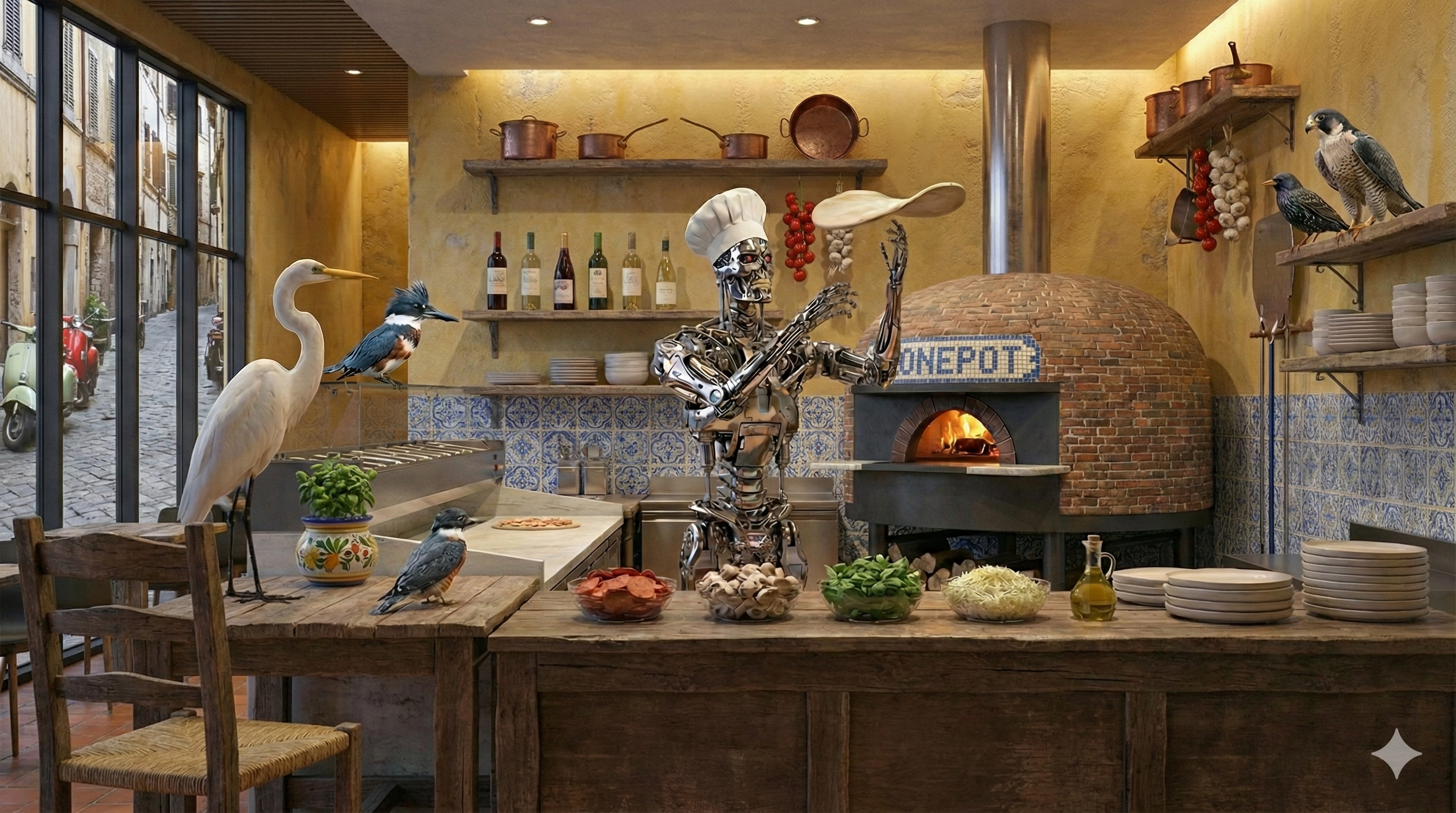
An AI-generated depiction of a robotic pizza restaurant, with Rowan-themed birds watching the chef. Image generated by Nano Banana Pro.
Corin: And I think that makes some amount of sense, right? There's some efficient way to compartmentalize the task. And it's a lot easier to sell pizzas. That's a more natural thing than to sell some mid-pizza intermediate or some pizza-making robot that needs to be integrated into a whole process. The market for pizza is clear. The market for pizza-making robots or pizza-based yield-prediction models is somewhat less clear.
If we take Andrei's thought experiment about the different layers and make that a little more specific: there's obviously a chemistry layer where you need to actually be running reactions that work well. There's an instrumentation layer where you need robotics and instrumentation for setup, running reactions, and analysis that work well. There's what you'd call a "tool ML" layer where you're trying to predict products and analyze instrument outputs, or maybe predict yields, and then there's some agentic ML layer where you're orchestrating all of it. You're managing everything that happens.
Where do you guys see that your big advances have happened so far? So are you inventing new reactions? New instruments? Is the magic in the integration? What are you doing that other folks haven't figured out yet?
Daniil: Yeah, it's a good question. So, automation is really straightforward. When you start doing something very complex, I always think that I'm going to hit a wall in what I'm doing—everybody says it's very hard—and then we start doing it and it just never happens. We just do it and still it's fine all the way down. It's a lot of work but still totally fine. So we don't see much of a problem on the automation side there. We have to customize existing hardware a little bit, but it's fine.
We do see a lot of gains on this tool ML layer. So Andrei probably could tell more about this, but it's the reason why we have success-based pricing. So if we fail an experiment, we're the ones who have to pay for it, which is very unfortunate. So there is very clear value from these models. I mean, you can literally calculate the economic impact of increasing your accuracy of the model by another 5%. It's very clearly translated.
And on the agentic side, it's another thing: if you could make a thought experiment and let's say replicate one of the largest companies that works in enumerated library space, you would need to get all the reactions, all the protocols, and develop them from scratch. Just imagine the amount of effort that will go on there. You would need chemists working on hardware, setting up the reactions, doing hundreds of experiments for every single reaction, then analyzing the data and making conclusions, then optimizing again. It's absolutely ridiculous.
Andrei: I also think that with our approach, we have the pieces that improve one another. So you know: one direction is we have the agents that have this broad intelligence, that have this literature knowledge, that can design high-level conditions for experiments. This is an exploration phase, a creative phase.
And then we also have another direction with custom models that are highly specialized to capture these patterns hidden in reaction data. They just complement each other really well: we have this general-layer intelligence and this specialized intelligence that captures things at the atom level. You know, you place a nitrogen somewhere, reactivity changes suddenly, and you need to find another route, maybe even get more steps there. It's a bit counterintuitive for humans and for LLMs as well, so having this specialized intelligence is very important.
Corin: That makes sense. You mentioned the success-based pricing. Will you guys talk a little bit about your business model, which I think is maybe not the way that most AI startups are thinking about making money or trying to build scalable businesses. How do you guys price and what drove you to do it this way?
Daniil: We start with an enumerated library space. Basically everything that we have, all the reactions we support in house, they all allow us to generate this enormous space of compounds that customers can choose from and where we are fairly certain that these compounds will be synthesizable or we're okay with taking the risk of reaction failure.
Customers can order compounds and get 0.5–1.5 mg of this compound delivered really really fast. The entry tier would be $125 per compound. And it's success-based. You can order 50 compounds, let's say we make 40, you pay only for the 40 successful syntheses and you're going to get them really really fast, much much faster than any competitor.
Andrei: I think, Corin, you made a good point that we have a fairly different business model from companies that do AI model development. We thought about, as Daniil said, making models ourselves and selling them to partners but what we found out is that people, in the end, just want pizza. Most of the time they don't want the pizza-making tools. And that just made a lot of sense and we found out that probably in a likely alternate universe, if we were working on just models, we would not get these deep insights that we can get by verticalizing the entire process.
Corin: That's something we've thought about here at Rowan, too, which is that as you take on more and more ambitious things that are closer and closer to what people actually want, you discover more things that are broken than you originally knew about. So at first you think that the place that you started in is everything, and then as you try to do more and more you realize a lot more where the value actually lies, which is good. That's an important thing to know.
Andrei: Yep.
Daniil: There's one thing that I like to ask any company that does automated synthesis: how do you purify compounds? Because you can have a really nice story about how you always work, but there is no purification. So that's one of the challenges that you see when trying to own the entire process.
Corin: How do you guys purify compounds?
Daniil: We use HPLC [high-performance liquid chromatography] with mass-based fraction collection. It still wouldn't be enough with a general method to work for most of the compounds. So we just develop methods that basically generate a custom protocol for every single reaction mixture to do purification. Again it's one of the things that people often ignore, but then you go to an event and an old-school chemist says that purification is the biggest challenge ever. It's manageable, and again if some compounds are not isolated, if the fraction is small enough, it's fine.
Corin: Have you ever thought about doing catch-and-release-style purification for various functional groups? I know Marty Burke at Illinois has looked into this.1 I've never seen it being used in an industrial context, so I'm not sure if there's limitations that aren't obvious from the paper.
Daniil: Yeah, it's a good question. What we aim for is a general and simple workflow for synthesis. So any custom work will come back to bite us later.
Corin: Makes sense. I've written before about how I'm skeptical that automation alone will be enough to solve synthesis in a huge moonshot way. If we take my thought experiment for this, which is "imagine we want to make taxol in a fully automated way," how long do you guys think it will be until this is possible? (Obviously this is speculation, so no one's going to hold you to this.)
And what do you think has to be solved to get there? If you imagine the future, contingent on this being possible at some point in the future, is it new chemistry? Is it just massively higher capacity and ability to experiment? Is it a very different sort of instrumentation? What's stopping us from making taxol now?
Daniil: I mean, right now, pretty much everything. You need instrumentation, but it's not necessarily something that cannot be solved. It's a tough problem, but it's an engineering challenge. It's not necessarily science that prevents you from getting there.
On the modeling side, being able to predict reaction outcomes better is really important. So if you can move beyond predicting the performance of Suzuki couplings to more complex chemistry and go beyond single named reactions and being able to capture more complex transformations that can happen as a molecule, then you would unlock this possibility of getting there.
But this unlock means that you need an insane amount of data about chemical reactivity. You can imagine all the different reactions just as huge clusters in this reaction chemical space, and you want to fuse the entire thing: you want to be able to generalize across all the different reaction types, and then if you get there then you solve taxol and all the other stuff.
Andrei: Yeah. You can imagine building the data-collection infrastructure that happens autonomously. In order to do that we probably still need a few advancements on the LLM side of things, like planning across a longer horizon, because with taxol I'm pretty sure it will be done autonomously but it probably will be a pretty long project. It's not going to happen in two hours, the 60 steps or however many there are, so it's still going to be this long-term project which may be done much faster than a human chemist would do it but still would require some time. So being able to iterate over such large projects is still very important and a big challenge generally.
Corin: You mentioned what I think of as a foundation model for reaction prediction. That's what I heard you say when thinking about fusing different categories of chemical reaction space: going from a Suzuki reaction model and an acylation reaction model and a nitration reaction model to a transferable foundation model for reaction prediction. Obviously there's a lot of work happening on the simulation foundation model side in terms of pre-training on large amounts of DFT data, sometimes in a supervised way and sometimes in more of a self-supervised way. Do you see that work connecting at all to what you guys are doing, or is it just a totally different set of questions?
Daniil: It definitely could be helpful as an initial representation of compounds, an initial representation of the reaction, and maybe some initial guess of where the process is going. In reality the problem is that DFT, like anything else, is still a model of what happens in the experimental world and whatever you use to describe your molecular system is also a model of the actual molecular system that happens in the real world. Our key philosophy here is that we want to double down on experimental data as much as we can.
The field historically has seen very little innovation on how you collect this data. So there are analytical methods that are known. People use LCMS [liquid chromatography–mass spectrometry] to analyze reaction mixtures. They see that LCMS takes five minutes per sample and they say, "well then we can collect this small number of samples." But a very small number of people have actually worked on developing better methods for data collection and the key unlock on the data collection side will influence how we can get to these models.
Andrei: And we really think that the data is something that limits the advancements in reaction modeling at scale, just because the datasets that are there… I mean, there's so few of them and generally there's just so much variance across them. It's pretty tough. There are all these variables that are not reported and generally the scale is pretty small. So if we want to take the lessons from deep learning and transfer them to chemistry, we really need to think about data a lot more than the field has done so far.
Corin: What do you guys think is the most underrated analytical method? Following on from your previous answer, it doesn't need to be something you guys currently use at onepot, but a technique that you think doesn't get the attention it deserves.
Daniil: Desorption electrospray ionization doesn't get as much attention as it should get. Graham Cooks from Purdue has done a lot of work there.
Generally, you know that organic chemists hate mass spec on average, and there are many reasons why. One of the reasons is that the signal is not guaranteed to be proportional to concentration, and you cannot just integrate a bunch of peaks and do the work. Even in LCMS it's going to stop being linear at some point. The reality is that for models it probably doesn't matter.
Corin: Do you guys use charged aerosol detection at all? Do you think that's a useful technique?
Daniil: Once you do purification, you get all the fractions. Ideally we wouldn't have to weigh the vials with fractions and we can estimate the mass concentration directly. So [charged aerosol detection] would be great. We ended up not getting it; we just got some numbers from one of the manufacturers, and the numbers were not good enough for what we wanted to get. But the idea of having a method that has such a uniform response across different components is great.
Andrei: That would be very helpful.
Daniil: It maybe can be approximated with a model. A model that learns small adjustments to response based on structure would be very useful.
Corin: I know we're getting close to the end of our time here. If we're watching onepot, what's the best-case scenario for you guys over the next two years? Where do you hope to be two years from now, in terms of what you've accomplished and what you've built out technically? What can we expect to see from your team?
Daniil: Well, we want everybody to forget chemistry. That's where we want to get. We want people to be able to discover drugs without looking at chemical structures a single time. We want to make molecules as accessible as possible. So if people think about not studying organic chemistry because onepot exists, it means that we did our job well.
Andrei: Also, we're very excited about just speeding up the iteration cycles and observing what will happen with the field as synthesis becomes not annoying.
Corin: So, two years from now, everyone will have forgotten chemistry.
Daniil: I mean, onepot will remember.
Corin: Anything else?
Andrei: Just keep an eye on our releases. We have some pretty cool plans and you'll hear more.
Daniil: Lots of stuff is cooking.
Andrei: Pizzas, pastas, salads…
Footnotes
- After this interview was recorded, Professor Burke co-founded Excelsior, a company using the aforementioned technology to accelerate small-molecule drug discovery. Here's the Endpoints coverage of Excelsior, and here's C&EN News.