Hits From a Hackathon

by Kat Yenko, Corin Wagen, Ari Wagen, and Derek Alia · Aug 7, 2026

This is a guest post in collaboration with Kat and Derek from muni. This post can also be found on their site.
A picture of someone fishing.

Girl Fishing at San Vigilio, John Singer Sargent (1913)

Most drug-discovery projects involve dozens or hundreds of people, multiple years of work, and lots of hard-to-encode experimental and organizational context that typically can't be disclosed for IP reasons. In contrast, the hackathon format gives us a clean and isolated way to study the decision-making of drug discovery: why certain compounds were picked, how tools were chosen and employed, and what ultimately ended up driving successful or unsuccessful compound selection.

In this post, we want to share which high-level approaches worked (and which didn't), go through the step-by-step agentic decision-making behind the muni autoresearch workflow, and then share our thoughts about the future of agentic medicinal chemistry.

Background

We hosted an agentic medchem hackathon with muni and onepot on Saturday, May 9th. Teams used muni to run agentic workflows, Rowan's scientific computing platform to run molecular simulations and predictions, and onepot's chemical space to identify compounds that could be synthesized.

8 teams of participants competed; over the course of 7 hours, all teams used a combination of AI agents, literature precedent, and computational-chemistry tools to design molecules. In the end, a panel of industry experts judged the submissions and selected winners based on scientific rationale and strategy. onepot, which handled synthesis, produced the highest-ranked feasible compound from each team. Those went to the Chordoma Foundation as part of their TBXT Challenge, which provides free binding assays to teams designing molecules against TBXT, an oncogenic transcription factor and high-value therapeutic target in chordoma (a rare cancer of the spine and skull base).

Since then, we've been eagerly waiting to learn how the compounds fared.

Experimental results

A total of 12 compounds were synthesized and tested, six of which the Chordoma Foundation classified as binders to full-length TBXT in a primary surface-plasmon-resonance (SPR) screen. For these assays, full-length TBXT was immobilized on the sensor chip, and compounds were tested for binding using a six-point, two-fold titration with a top concentration of 50 µM. We use their classifications throughout, while following the spirit of Boltz's recent blog post on reporting by sharing underlying sensorgrams and noting where signals are noisy or non-saturating.

CompoundTeamSPR resultReported affinity (Kd)
muni C01Türkish DelightsNon-binderN/A
muni C02Traditionally ModernNon-binderN/A
muni C03The FlintstonesNon-binderN/A
muni C04Enamine Ltd.Non-binderN/A
muni C05JJSXBinder; dose-dependent but non-saturable>20 µM
muni C06Liau LabBinder; dose-dependent but non-saturable>20 µM
muni C07Transcripta TxNon-binderN/A
muni C08Need More GPUNon-binderN/A
muni C09muni autoresearchBinder; clear dose-dependent response16 µM
muni C10muni autoresearchBinder; noisy across three independent runs5-10 µM (low confidence)
muni C11muni autoresearchBinder; dose-dependent but non-saturable>20 µM
muni C12muni autoresearchBinder; dose-dependent but non-saturable>20 µM

The six binders include all four compounds generated from our autoresearch pipeline, along with the JJSX and Liau Lab top submissions. C09 resulted in the cleanest response, with a Kd of ~16 µM. C05, C06, C11 and C12 were dose-responsive but didn't saturate within the tested range. C10 produced noisy and inconsistent sensorgrams across three independent runs.

Non-binders here shouldn't be interpreted as failed approaches here, nor should these results be interpreted as a comparison of the teams' workflows. Each team, except for our autoresearch pipeline, was represented by only one compound, which was the first candidate in its ranked list that onepot could synthesize. It's entirely possible that the reported pipelines give excellent hits that weren't the selected compound; the overall hit rate from this screen (50%) is quite good by typical drug-discovery standards and a single failure should not be taken as an indictment of a pipeline.

The corresponding sensorgrams and concentration-response plots for compounds classified as binders and non-binders in the primary screen are below:
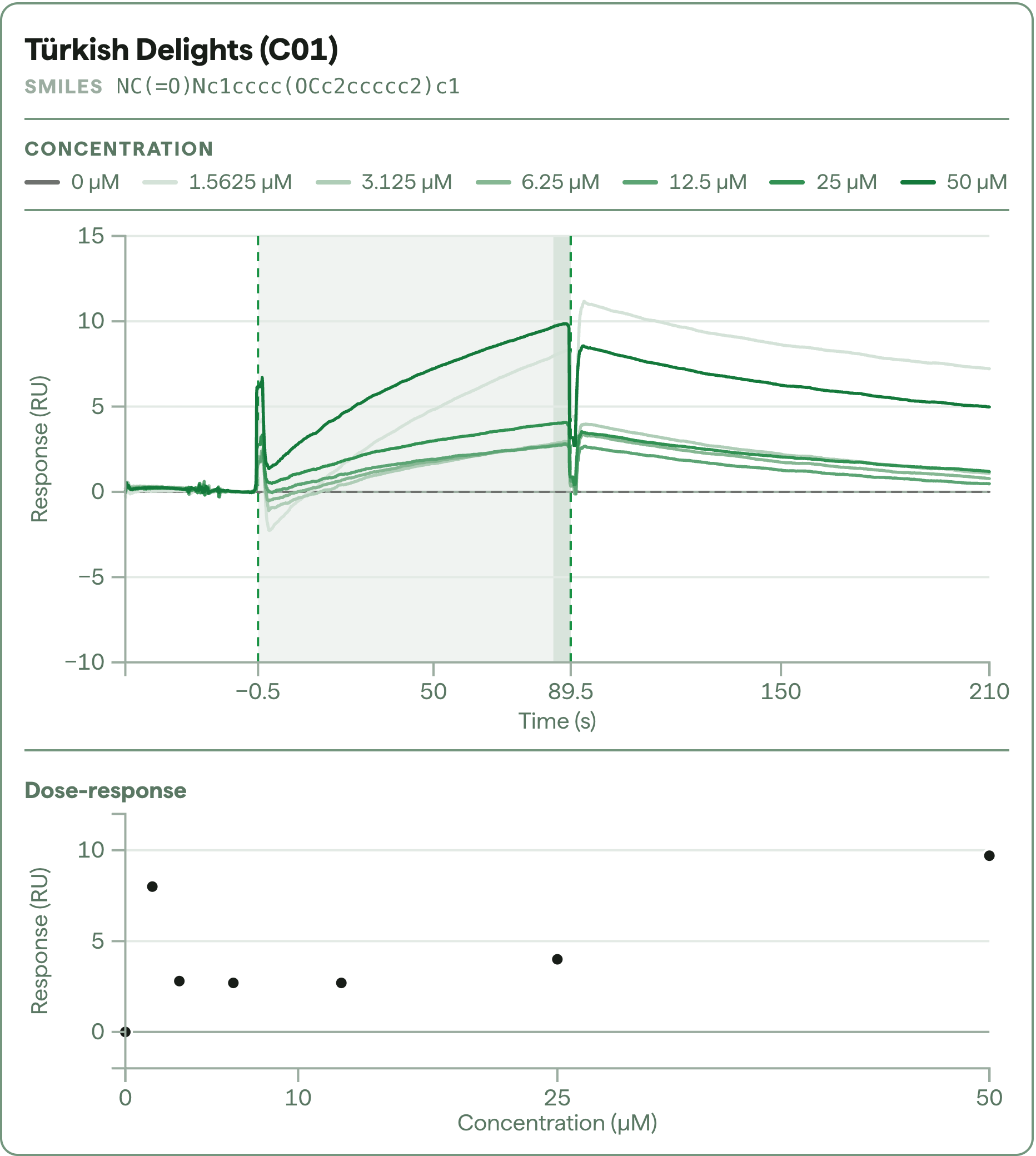
Sensorgram and dose-response plot for Türkish Delights (C01).

Full release of the data can be found here: https://github.com/bioArena/tbxt-hackathon-data.

Different strategies

With these ground-truth experimental results in hand, what can we learn about the computational pipelines? It's helpful to start by looking at what the different teams actually did.

Some teams used structure-based methods (docking, protein-ligand structure prediction), others relied more on QSAR, pharmacophores, or similarity to known binders. Several teams combined both of these approaches together, then filtered with ADMET prediction and/or by what was synthesizable by onepot. The table below summarizes the high-level approaches used:

TeamApproachResult
Türkish DelightsSix-conformation Vina ensemble; GNINA; TBXT RF/XGBoost QSAR trained on 650 SPR measurements; Boltz-2; SCC; MM/GBSA; T-box paralog-selectivity checksNon-binder
Traditionally ModernFragment, property, PAINS, and synthesis-risk filters; XGBoost ranker trained on prior TBXT SPR data; diversity clustering; Boltz pose and pocket checks; Vina dockingNon-binder
The FlintstonesVisual inspection and Boltz for two candidates; DiffSBDD optimization, onepot similarity search, and Boltz for two candidatesNon-binder
Enamine Ltd.Bioisostere generation in onepot chemical space using RDKit and a diffusion model; Rowan dockingNon-binder
JJSXRDKit pharmacophore screening; ADMET-AI; Vina; Boltz-2Binder
Liau LabIterative onepot similarity searches starting from three leads; MOE docking; Rowan protein–ligand dockingBinder
Transcripta TxPyMOL analysis; chemical diffusionNon-binder
Need More GPUPocketeer pocket consensus across structures; fragment identification; onepot substructure matching; Prophet proliferation screening; Schrödinger induced-fit dockingNon-binder
muni autoresearchClaude Opus 4.7–directed iterative design using CReM and onepot, with QVina2/GNINA docking, Boltz-2, Rowan ADMET, RBFE, and MD4/4 binders

The three successful teams followed three different but related strategies, two of which we'll briefly detail here. (We weren't able to get additional detail from "Liau Lab.")

How JJSX selected compound C05

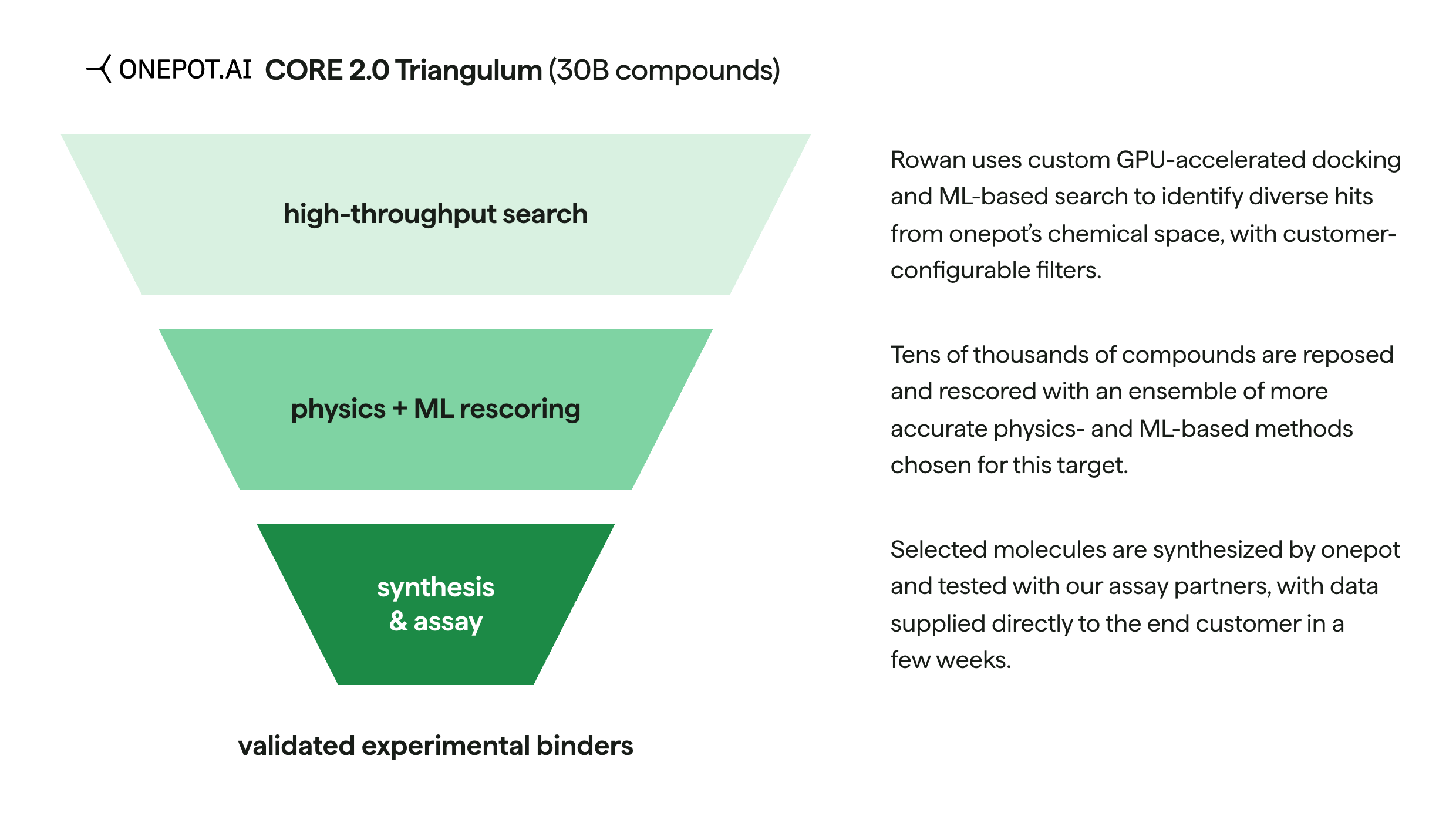
JJSX focused on scaffold hopping around D203-0031, a known pocket F binder. They first searched onepot CORE for available scaffold replacements, then filtered those down to drug-like compounds using property + PAINS filters. Docking calculations were performed through Rowan using Vinardo for pocket F against the TBXT structure PDB 5QSA. Compounds were prioritized if they produced a more favorable Vinardo score than the reference compound (D203-0031), preserved the known Y88 interaction, and yielded poses that passed PoseBusters validation. The compounds that passed these filters were ranked by Boltz-2 using predicted IC50, binding probability, and model confidence.

Unlike other teams that relied more on QSAR models trained on prior TBXT data, JJSX prioritized a more classic structure-based workflow with pharmacophore matching, docking poses, and protein–ligand interactions. They'd planned to use FEP in a final triage step but weren't able to with the time constraint. Their submitted and synthesized compound, muni C05, showed binding activity with KD > 20 µM.
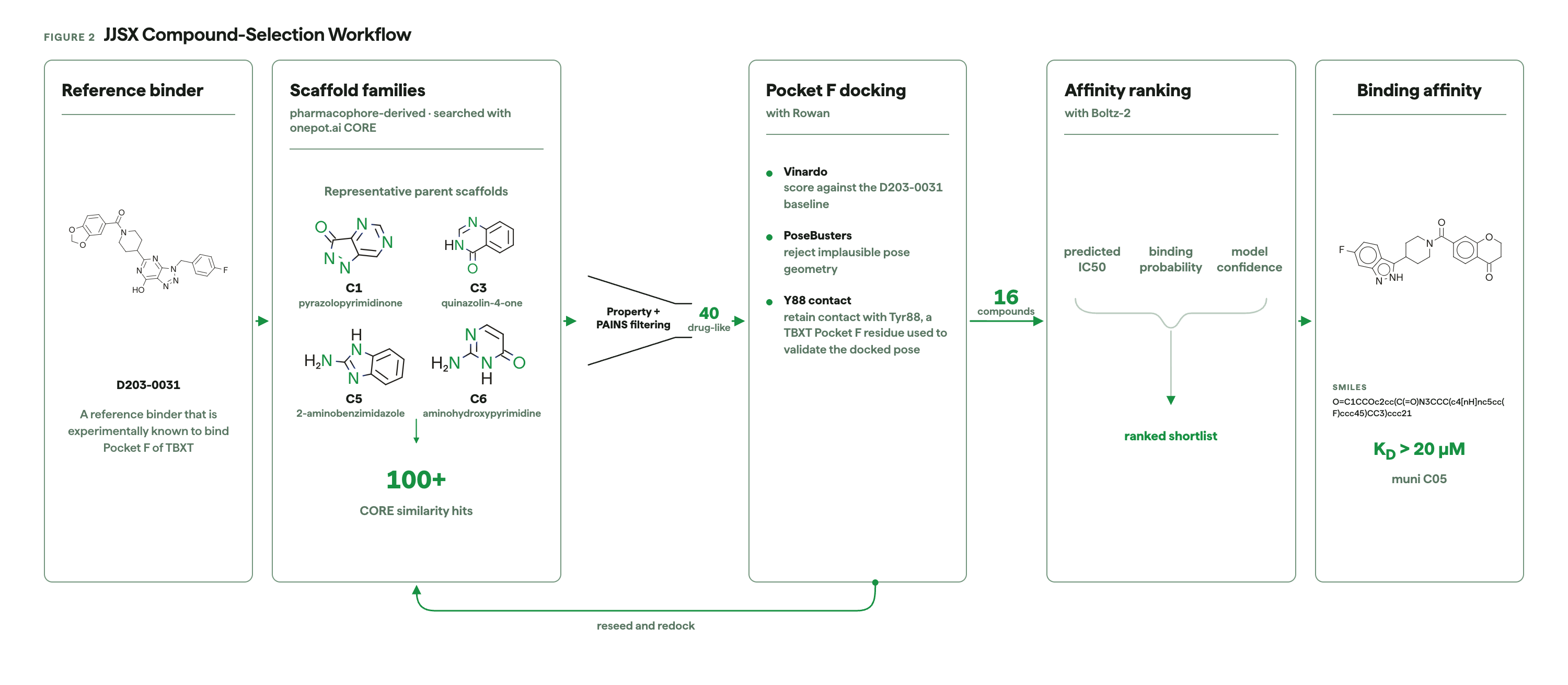

The aforementioned JJSX strategy.

How muni autoresearch selected compounds C09, C10, C11 and C12

The full recap of our autoresearch run can be found here, but TL;DR — our binders came from iterative compound generation and inexpensive filtering. This adaptive search strategy was initiated with analogue generation through CReM, Boltz-2's affinity head as the main triage method, and finally docking and ADMET as plausibility checks. C12 came from an early series, C11 from refinement of that same lineage, and C09 and C10 from a later pivot to analogues of an experimentally validated binder family. The agent attempted to refine the rankings with FEP and MD, but because results were low-confidence or non-discriminating, it restored candidates that FEP initially demoted. SPR later validated those candidates as binders.

We cannot prove that the agent would've submitted the same four without FEP or MD. Still, neither method was required to keep the compounds eligible. It's possible that this outcome reflects room for optimization on the implementation side, rather than a limitation inherent to either method.

Discussion

State-of-the-art tools work pretty well

Successful teams used prosaic tools: docking, MD, pose inspection, pharmacophore methods, perhaps a little FEP. Apart from protein–ligand co-folding, none of the above workflows would have been out of place a decade ago (or more). What's different about today, then? Setting aside the question of AI agents, which we'll get to in a second, we think that the modern software stack has dramatically increased the efficiency and reliability of these tools.

Computer-assisted drug discovery works best at scale. Ten years ago, one of the authors (Corin) worked on a med-chem project where docking was run one compound at a time, manually, by clicking buttons in a GUI. Unsurprisingly, the hit rate from docking 20 compounds was pretty low, and like many scientists at the time I decided that computation wasn't practically useful in drug discovery—a conclusion that, given my resources, was correct.

Things are different today. It's now possible to upload thousands of compounds to Rowan or Muni, go to lunch, and come back to a ranked list of compounds that have been carefully docked, filtered, & scored using state-of-the-art methods and checks. Even expensive techniques like MD or FEP can take just minutes with modern GPU hardware—that's how we're able to host a hackathon where participants run an entire virtual-screening campaign in just a handful of hours.

As it becomes affordable and simple to run computational chemistry at scale, the returns to running computational screens increase. We estimate that our successful TBXT autoresearch run cost around $750 all told. If in the future anyone can spend <$1000 to find micromolar hits on difficult drug targets, we expect that many more people (and companies) will find it worthwhile to run virtual screens.

At core, the promise of computer-assisted drug discovery is to take drug discovery, a problem that scales via expensive wet-lab iteration cycles, and transmute it into a problem that scales via cloud compute and Moore's law. As software continues to get cheaper, faster, and more capable, we expect that virtual screening will become more and more attractive—even absent any fundamental revolution in how we approach small-molecule drug discovery.

Why use agents at all?

Tools like Rowan make it "simple" to encode complex multi-step chemical design processes in code. What, then, is the merit of having an AI agent in the loop?

For known workflows, code is enough

Agents aren't inherently better at multistep processes. When the sequences, inputs, and contingencies are known—a simple PCR protocol, for example—a conventional program is usually more reliable. Ghareeb et al. describe their multi-agent system: an orchestration layer was encoded to improve stability after observing that its agent almost always called tools in the same order, but retained agents for hypothesis generation and data analysis.

Similarly, Kusne et al. used physics-informed active learning to select which compositions to measure in a materials library, discovering a new phase-change material without having to measure the entire library, and all without an LLM agent! These dynamic workflows are often better expressed as code when their objectives and possible actions can be defined in advance.

Agents are currently good at absorbing operational uncertainty

But when workflows diverge from the happy path, agents become useful. This happens all the time in software—APIs change, output formats differ, or version updates introduce backward-compatibility bugs. In Boiko et al., for example, their Coscientist generated an invalid command for a recently released heater-shaker, consulted instrument documentation, corrected the API call, and finished the execution successfully (without human intervention).

AutoLabs is another case where reasoning-enabled configurations reduced quantitative errors by over 85%, while iterative self-correction improved protocol correctness. Both cases demonstrate an effective division of labor where experts guide the strategy and agents handle implementation and validation.

OK, agents can fix software; but can they have good scientific judgment?

The "you're absolutely right" agents are becoming artifacts of the past as agents get better at recognizing when a working hypothesis is yielding diminishing returns. We saw this in our autoresearch run: after three rounds produced only one strong predicted binder and a chemically narrow set of incumbents, the agent seeded the last round from other validated TBXT binder families, producing submissions that were later confirmed as binders.

It's a small-n but meaningful example of an agent successfully navigating around what's identified as a bottleneck for AI scientists in Lilian Weng's Harness Engineering for Self-Improvement: learning from failure enough to abandon an unproductive research path. A lot of what "good" scientific judgment involves is being able to do this repeatedly through understanding the failure modes and exploring better alternatives based on this feedback. As both general-purpose language models and domain-specific tools continue to improve, we probably won't need to build a bespoke AI scientist for every field. Instead, while domain expertise stays in the tool development, the agents should be responsible for understanding how to use them.

Concluding thoughts

This single result doesn't prove that "AI has solved medicinal chemistry." TBXT is a target with known hits and a significant corpus of structural data, making this a relatively computationally legible challenge, and the hits are still weak and would require considerable additional effort to promote further. Setting all this aside, though, we can ask some forward-looking questions: what will drug discovery look like if hit discovery and lead optimization become "easy"?

Reducing development cost and cycle times, while valuable, won't naïvely allow us to discover hundreds of new drugs per year. New bottlenecks will quickly emerge: clinical trials are one obvious blocker, but target selection and fundamental disease biology may prove even more difficult to tackle. If the amyloid hypothesis is false, can we find novel targets for Alzheimer's?

Wet-lab validation is the only sufficiently ambitious standard for evaluating agentic drug discovery systems. As experiments get cheaper and faster, we'll be able to generate far more data, but the data are only valuable if the successes and failures are interpretable. Having rich experimental records—the observed endpoint, experimental context, and enough mechanistic reason to discern between a lack of binding, no phenotypic rescue, toxicity, etc.—and producing these at speed will give agents the right evidence to govern subsequent decisions and compress traditional biotech timelines.

We're energized and excited to continue running these loops and publicizing where they do well & where they break.

Acknowledgements

A huge thank you to the entire Chordoma Foundation team for posing the challenge and sharing the data, with special thanks to Lee Dolat for leading the binding assays and Yaguang Si for coordinating the effort; to muni for planning, organizing, and executing the hackathon; to onepot for compound synthesis; and to our judges and every participant who spent a Saturday turning computational ideas into compounds we could actually test.

Banner background image

Start running calculations in minutes!

Our platform lets you submit, view, analyze, and share calculations using cutting-edge methods trusted by hundreds of leading scientists. We give every new user 500 free credits to start, plus more every week. Making an account and running your first calculation takes only seconds: start using Rowan today!

Start computing →

What to read next

Hits From a Hackathon

Hits From a Hackathon

How certain schemes to identify TBXT-binding compounds have succeeded.
Aug 7, 2026 · Kat Yenko, Corin Wagen, Ari Wagen, and Derek Alia
Testing Different Pose-Ranking Methods for RBFE Calculations

Testing Different Pose-Ranking Methods for RBFE Calculations

Benchmarking how well Rowan's analogue-docking pose scoring picks the best starting structure for RBFE, and how much a ranking miss actually matters downstream.
Aug 6, 2026 · Zachary Fried
LogP, API Key Budgets, and a User Survey

LogP, API Key Budgets, and a User Survey

the golden mean of logP; three approaches to predicting logP; API key budgets for low-trust delegation; a user survey and some blog posts
Aug 5, 2026 · Nick Casetti, Ari Wagen, Spencer Schneider, and Corin Wagen
How to Find Conformers

How to Find Conformers

A conceptual overview of conformer-generation and conformer-search methodology.
Aug 3, 2026 · Nicholas Casetti
Simulation Tools Improve Agent Problem-Solving

Simulation Tools Improve Agent Problem-Solving

External simulation tools do noticeably improve agent performance at 13C NMR structural elucidation.
Jul 31, 2026 · Corin Wagen
NMR Spectroscopy

NMR Spectroscopy

the importance of NMR spectroscopy; the languorousness typical of state-of-the-art methods; MagNET, a new model, and its Rowan workflow; testimonials and case studies; new agent benchmarks
Jul 23, 2026 · Corin Wagen and Eli Mann
Testing Rowan-Enabled Agents on DrugDiscoveryBench

Testing Rowan-Enabled Agents on DrugDiscoveryBench

How access to Rowan's computational tools affects scientific agents' performance on early-stage drug-discovery tasks.
Jul 21, 2026 · Eli Mann
Automating Transition-State Search

Automating Transition-State Search

strings and bands; interpolating between states; searching for transitions; confirmation; Vicena integration; recent blogs
Jul 20, 2026 · Jonathon Vandezande and Corin Wagen
Case Studies with Rowan's Hydration-Site Analysis

Case Studies with Rowan's Hydration-Site Analysis

Benchmarking Rowan's hydration-site detection on five documented protein–ligand complexes.
Jul 16, 2026 · Ishaan Ganti and Corin Wagen
What to Do with a Pose

What to Do with a Pose

A few helpful ideas for further analysis or calculations to run.
Jul 15, 2026 · Corin Wagen