How to Find Conformers
by Nicholas Casetti · Aug 3, 2026
Conformational sampling is a critical component of many computational-chemistry workflows. Molecular docking, quantum-chemistry calculations, and physics-based property-prediction methods all depend on having access to relevant molecular conformations. Unfortunately, identifying these conformations is often much more difficult than optimizing a single structure.
At its core, the challenge is that conformational space grows rapidly as molecular flexibility increases. The number of possible conformations grows exponentially with the number of rotatable bonds, which means even a handful of rotatable bonds can make a conformational space intractable to enumerate exhaustively. Furthermore, important conformational changes often require the coordinated motion of multiple torsions, making them difficult to discover through simple bond rotations alone.
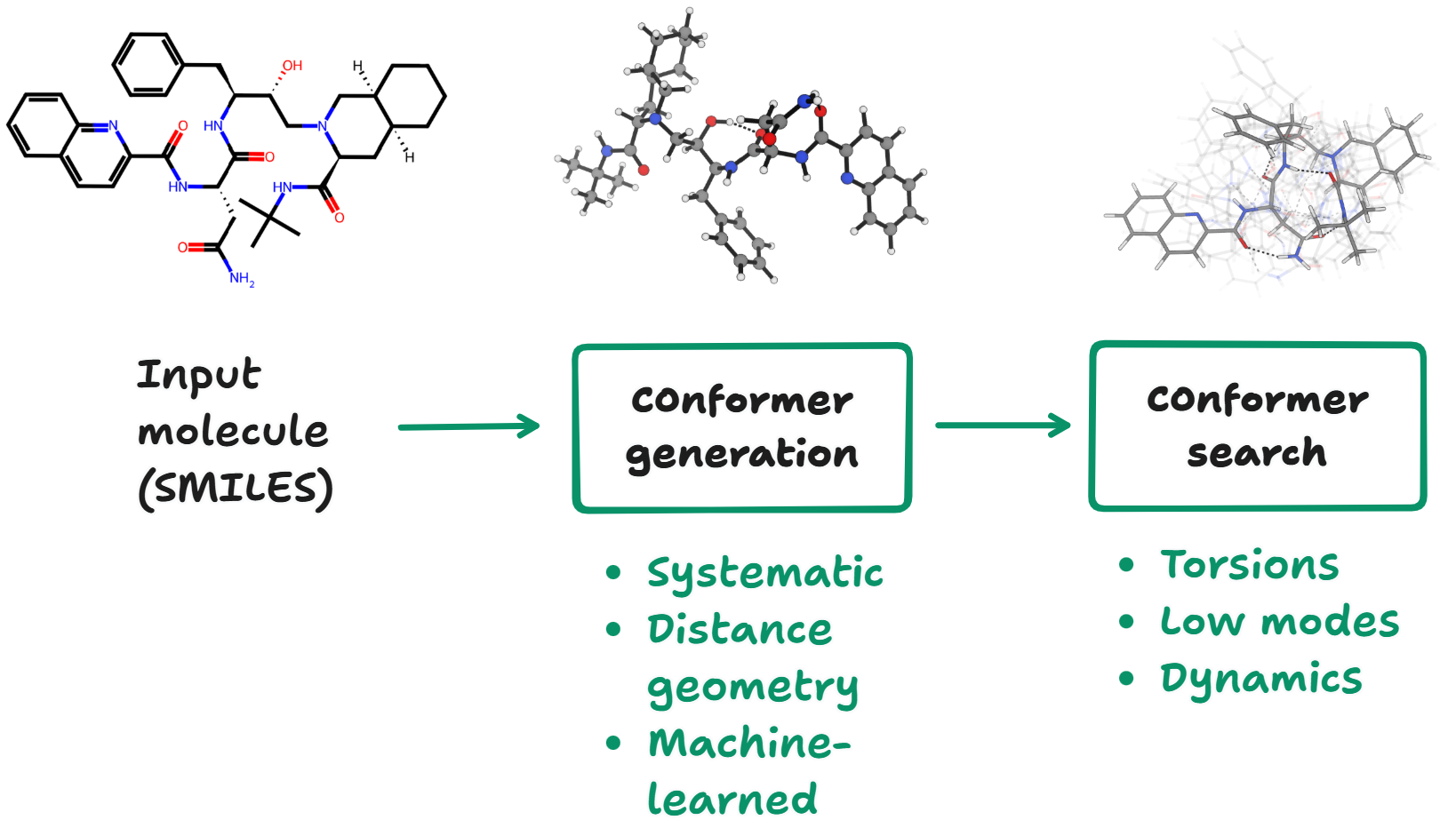
To address this challenge, computational chemists typically divide the problem into two stages. First, one or more reasonable starting conformations are generated from a molecular representation such as a SMILES string. Second, these conformations are used as seeds for conformer-search algorithms that further explore the surrounding conformational space. In this blog post, we'll discuss the major classes of conformer-generation and conformer-search algorithms, how they work, and when each method is most effective.
Conformer-Generation Methods
A natural question to ask when thinking about searching conformational space is "where does the first conformer come from?" Although conformer searches are sometimes performed on a particular structure of interest (like a transition state), oftentimes an equilibrium structure must be generated from the SMILES of a molecule. This is the task of a conformer-generation algorithm.
Historically, computational chemists would perform this task manually, but modern workflows often involve hundreds or thousands of molecules and may require multiple conformers for each. At this scale, automated methods become essential. These methods can be broadly divided into systematic, distance-geometry, and machine-learning approaches.
Systematic Conformer Generation
Systematic conformer-generation methods construct molecular geometries by explicitly enumerating physically reasonable combinations of bond lengths, bond angles, and torsion angles. These values are typically derived from experimental crystal structures or high-level quantum-chemical calculations. By systematically exploring combinations of these geometric parameters, a fully representative set of candidate conformers can be generated.
The primary advantage of systematic methods is robustness. Systematic exploration yields complete coverage of the conformational space by design. However, this robustness comes at a cost. Since the number of possible conformers grows exponentially with molecular flexibility, systematic enumeration is impractical for larger molecules. As a result, systematic methods are generally restricted to relatively rigid molecules or are combined with pruning strategies that eliminate unlikely conformations during generation.
Key Publications
- This paper from Stahl and co-workers describes the implementation details of OpenEye's systematic conformer generator for OMEGA.
Distance-Geometry Conformer Generation
Distance-geometry methods generate conformers by first constructing a set of geometric constraints instead of directly specifying atomic coordinates or distances. These constraints are typically expressed as upper and lower bounds on interatomic distances derived from molecular connectivity, stereochemistry, and experimentally observed molecular geometries. Candidate conformers are then proposed by generating coordinates that satisfy these constraints.
Modern distance-geometry methods such as ETKDG combine this embedding procedure with knowledge-based corrections derived from experimentally observed molecular structures. This approach allows conformers to be rapidly generated while still producing chemically realistic geometries.
Because conformers are generated through stochastic sampling of the distance constraints, distance-geometry methods generally scale much better than systematic enumeration and have become the dominant approach for generating starting conformers for drug-like molecules. The primary limitation of distance-geometry methods is that they are designed to produce plausible conformers, not to exhaustively explore conformational space. As a result, additional conformer-search methods are often required when comprehensive conformational coverage is important.
Key Publications
- This paper from Sereina Riniker and Greg Landrum describes the implementation of and improvements to RDKit's stochastic conformer generator, ETKDG.
Machine Learning–Based Conformer Generation
Machine-learning methods approach conformer generation as a prediction problem. Rather than explicitly encoding geometric rules or distance constraints, these methods learn patterns from large collections of molecular conformers and directly generate three-dimensional structures. Recent generative architectures like diffusion and flow matching have improved the performance of machine-learned conformer generation by better capturing the underlying distribution of molecular conformations present in the training data.
The primary advantage of machine-learning methods is speed. Once trained, these models can rapidly generate conformers for large numbers of molecules while often matching or exceeding the quality of traditional approaches. However, their performance ultimately depends on the quality and diversity of their training data. Molecules that differ substantially from the training distribution may be more challenging, and the resulting models can be difficult to benchmark and compare with physics- or rule-based methods.
Key Publications
- This paper from Jing and co-workers details a diffusion model for conformer generation.
Conformer-Search Methods
Once an initial seed conformer or conformer ensemble has been established, it is often prudent to further explore the conformational space. Conformer-search algorithms accomplish this by generating new conformations from one or more seed structures and evaluating whether they represent previously undiscovered local minima. The methods discussed below offer different tradeoffs between speed, robustness, and conformational coverage.
Torsion-Based Conformer Search
One simple way to go about building a conformer ensemble is by directly rotating bonds and seeing which rotations result in different, lower-energy conformers. This is an effective strategy for rapidly enumerating a large pool of conformers. These methods tend to employ the following procedure:
- Randomly select a set of torsion angles in the molecule.
- Modify those torsion angles by a random amount.
- Relax the modified molecule to determine whether the conformer is worth keeping (by comparing its geometry and energy to the rest of the accepted conformers).
- Repeat for a set number of iterations.
Torsion-based methods excel for molecules whose conformational changes can be described primarily as rotations around a small number of bonds like in small and drug-like molecules. Because only a subset of molecular degrees of freedom are modified at each step, these methods are typically very efficient and can generate large conformer ensembles with relatively little computational effort.
The primary limitation of torsion-based methods is that not all conformational changes can be decomposed into independent bond rotations. Molecules with highly correlated motions, constrained ring systems, or macrocyclic topologies often require many torsions to move simultaneously. Although these correlated motions can be added to sampling (i.e. crankshaft, kinematic ring closures, etc.), torsion-based methods may struggle to efficiently discover relevant conformers.
Key Publications
- This paper from Chang and co-workers details the standard algorithm for torsion-based search.
Low-Mode Search–Based Conformer Search
A more physics-inspired method for conformer search involves scanning along the low-energy vibrational modes of the molecular Hessian. These modes often correspond to molecular "breathing" distortions and can provide access to local minima that are difficult to discover with a torsion-based approach. Low-mode search methods work by evaluating the molecular Hessian of an input conformer, identifying the low-energy vibrational modes, and scanning along them (which simply means distorting the geometry in the direction of vibrational mode). These distorted geometries are then relaxed into local minima and added to the conformer ensemble.
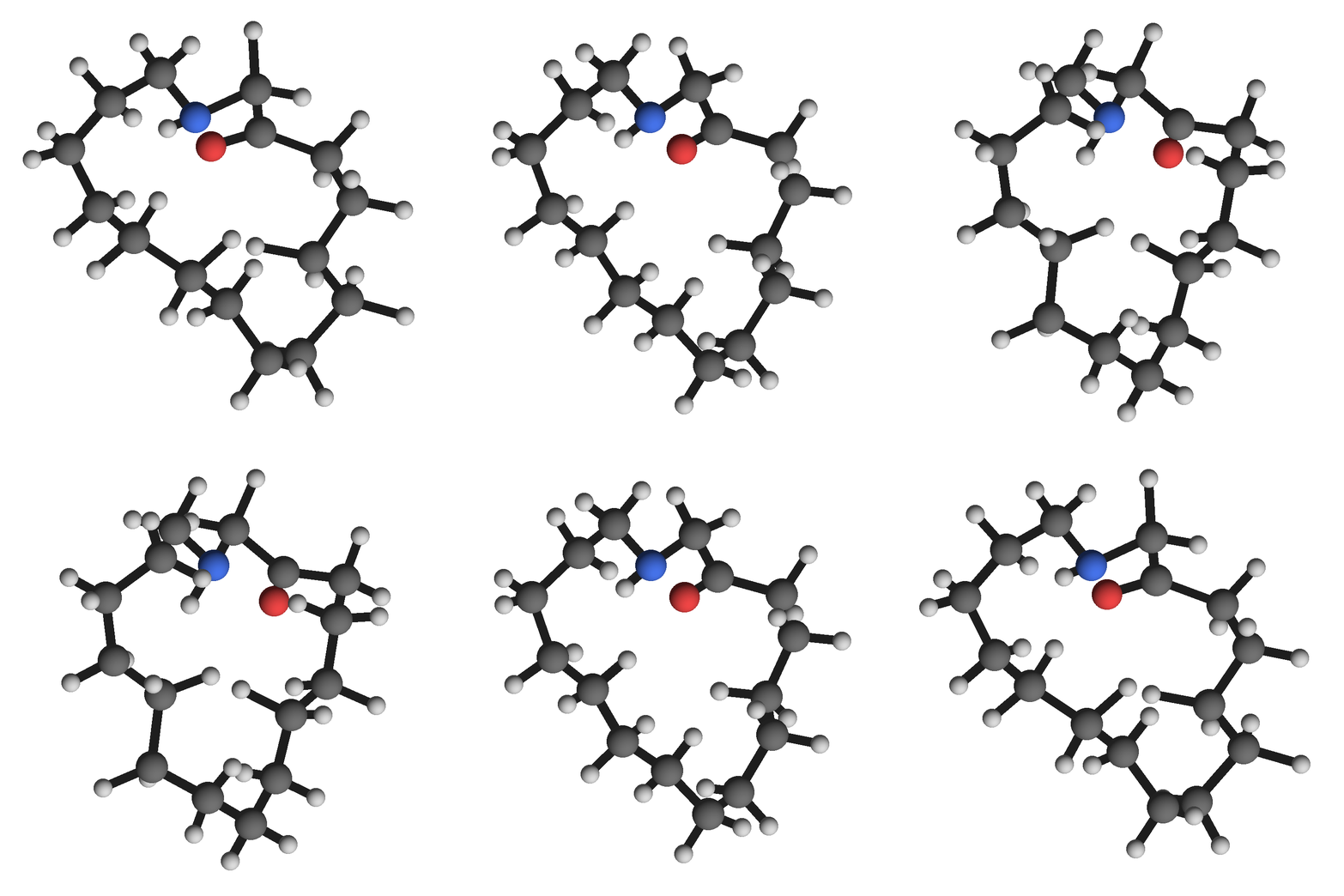
A low-mode frequency of the macrocycle azacyclohexadecanone
Low-mode search methods are particularly effective when exploring molecules whose conformational changes involve coordinated motion of many atoms. By perturbing structures along low-energy vibrational modes, these methods can efficiently discover conformers that would be difficult to reach through independent torsion rotations alone. This makes them especially useful for challenging systems such as macrocycles, bridged ring systems, and other molecules with highly coupled degrees of freedom.
The primary drawback of low-mode methods is computational cost. Identifying low-energy vibrational modes requires evaluating the molecular Hessian, which is substantially more expensive than modifying a handful of torsion angles. Furthermore, low-mode searches assume that relevant conformational changes can be approximated by distortions along local vibrational modes. While this is often true near a local minimum, important conformational transitions that involve large-scale rearrangements may still be difficult to discover. As a result, low-mode methods often provide better conformational coverage than torsion-based approaches, but at the expense of additional computational effort.
Key Publications
- This paper from Kolossváry and Guida describes the standard low-mode search implementation.
Dynamics-Based Conformer Search
Dynamics-based methods directly explore a molecule's potential energy surface (PES) to find new local minima. They accomplish this by simulating the molecule's motion with molecular dynamics and recording whenever it enters a new local minima. Thermal fluctuations allow the molecule to cross energy barriers and explore new regions of the PES. This process is often accelerated using metadynamics, which biases the simulation toward new regions of the PES by energetically penalizing previously explored conformations.
Because dynamics-based methods explore conformational space by following physically realistic molecular motions, they can discover conformers that are difficult to identify with either torsion-based or low-mode approaches. This makes them particularly useful for challenging systems such as transition metal complexes and highly flexible molecules.
The tradeoff is computational cost. Molecular dynamics and metadynamics simulations require many energy and force evaluations and may still become trapped in local minima if enhanced sampling techniques are not employed. As a result, dynamics-based approaches are generally slower than torsion-based and low-mode search–based methods, but often provide more complete coverage of conformational space.
Key Publications
- This paper from Pracht and co-workers details the metadynamics-based conformer search tool CREST.
- This paper from Laio and Parrinello lays the groundwork for all metadynamics algorithms.
What Should I Use?
No conformer search algorithm is universally optimal. Each method differs in how it explores conformational space and therefore performs best on different classes of problems. Similarly, different tools blend the use of different methods giving them various advantages and disadvantages. Below are a list of tools that are commonly used for conformer search and generation with a brief description:
| Tool | Description | Open source? |
|---|---|---|
Conformer Generation Tools | ||
| RDKit's ETKDG | Distance-geometry conformer generator that combines stochastic embedding with experimentally derived torsional preferences. | ✓ |
| OpenBabel's Confab | Systematic conformer generator that exhaustively enumerates torsion combinations within user-defined limits. | ✓ |
| Schrödinger's ConfGen | Knowledge-based conformer generator optimized for rapid generation of diverse, drug-like conformers. | ✗ |
| Balloon | Genetic algorithm–based conformer generator that optimizes molecular geometries using forcefield energies. | ✓ |
| Torsional Diffusion | Diffusion model that generates conformers by learning torsional distributions from large conformer datasets. | ✓ |
| ET-Flow | Flow-matching conformer generator that directly predicts molecular conformations from learned geometric distributions. | ✓ |
| LoQI | Diffusion model conformer generator trained on quantum-chemical conformer data to rapidly generate low-energy structures. | ✓ |
Conformer Generation and Search Tools | ||
| Rowan's openconf | Open-source torsional Monte Carlo workflow for conformer generation and conformer search with optional low-mode search | ✓ |
| OpenEye's OMEGA | Conformer generation toolkit based on fragment assembly and knowledge-based torsion sampling that can operate in both systematic and stochastic modes. | ✗ |
| Molassembler | Graph-based molecular construction toolkit with integrated conformer generation and stereochemical sampling capabilities. | ✓ |
| CONFORGE | Open-source conformer generator that combines knowledge-based systematic sampling for small molecules with distance-geometry–based sampling for macrocycles. | ✓ |
| MOE | Commercial molecular-modeling platform containing multiple conformer-generation and conformer-search algorithms | ✗ |
Conformer Search Tools | ||
| Schrödinger's MacroModel | Comprehensive conformational sampling platform implementing MCMM, LowModeMD, and related search algorithms. | ✗ |
| CREST | Metadynamics-based conformer search tool built on xTB that excels at sampling flexible molecules and macrocycles. | ✓ |
| MMMC | Open-source implementation of multiple minimum Monte Carlo conformer searching. | ✓ |
Our recommendations are binned into three separate use cases in increasing computational expense and fidelity:
- For many workflows, only a single conformer is necessary or feasible to compute. In these cases, the RDKit's ETKDG represents a fast and reliable way of generating a quality conformer.
- For workflows where a small, representative set of conformers is necessary, like many property-prediction tasks, we find that openconf does an excellent job of balancing speed and coverage for small and drug-like molecules.
- In cases where the conformational landscape is trickier and coverage is important, CREST's metadynamics-based approach consistently provides solid performance.
However, all of the tools above have their own distinct advantages, thus it's important to understand the conformational landscape and necessary level of fidelity of your use case to best determine which tool will be optimal for you.