Do Co-folding Models Notice When You Change the Pocket?
by Spencer Schneider · Nov 2, 2026
I generated the data for this post during our recent company-wide retreat in the Finger Lakes, running six of the co-folding models in Rowan through a set of published pocket-mutation experiments.

Isaac Blessing Jacob by Govert Flinck (1638)
Co-folding models are very good at producing plausible protein–ligand complexes. A harder question is how they get there: are they responding to the interactions in the pocket, or recognizing a familiar protein and putting the ligand where it usually goes?
Last year, Masters, Mahmoud, and Lill tested this with a clever set of experiments. Instead of asking models to predict known complexes, they mutated the binding pocket in ways that should make the original ligand pose unlikely:
- Glycine: replace the pocket residues with glycine, stripping away the side chains that contact the ligand.
- Phenylalanine: replace them with phenylalanine, filling the pocket with bulky rings that block the original pose.
- Inversion: replace each residue with the amino acid most chemically dissimilar to it (by Miyata distance), scrambling the pocket's chemistry.
They found that the models they tested often kept the ligand close to its crystal pose anyway, even when the pocket no longer made much sense for it.
We wanted to see how the various co-folding models available through Rowan handle the same tests. We ran the paper's CDK2 and MEK1 case studies through Boltz-2, Boltz-2.1, OpenFold-3, DeCAF-Boltz, ESMFold-2, and ESMFold-2-fast, and repeated the paper's CASF-2016 benchmark with ESMFold-2-fast.
How We Ran the Tests
We ran every model at Rowan's defaults (shown below), with five samples, no templates, and physics-based steering potentials off.
| Model | Recycling rounds / trunk loops | Diffusion steps |
|---|---|---|
| Boltz-2 | 3 | 200 |
| Boltz-2.1 | 3 | 200 |
| OpenFold-3 | 3 | 200 |
| DeCAF-Boltz | 3 | 10 |
| ESMFold-2 | 20 | 100 |
| ESMFold-2-fast | 3 | 50 |
For each condition, we generated five samples, kept the one with the highest aggregate confidence score, and measured its ligand heavy-atom RMSD to the wild-type crystal pose after aligning on protein Cα atoms. Following the paper, we call a pose "native-like" if that RMSD is under 2 Å.
For CDK2, we used the inputs the authors deposited alongside the paper; for MEK1, we built the mutants from the substitutions described in the Methods. The CASF runs used ESMFold-2-fast on Rowan and cover all of the paper's 285 complexes.
This isn't an exact replication. Templates, ligand preparation, and some analysis details differ from the original study, and we didn't repeat the paper's free-energy calculations. But the mutations and test systems are the same.
CDK2 and MEK1 Respond Very Differently
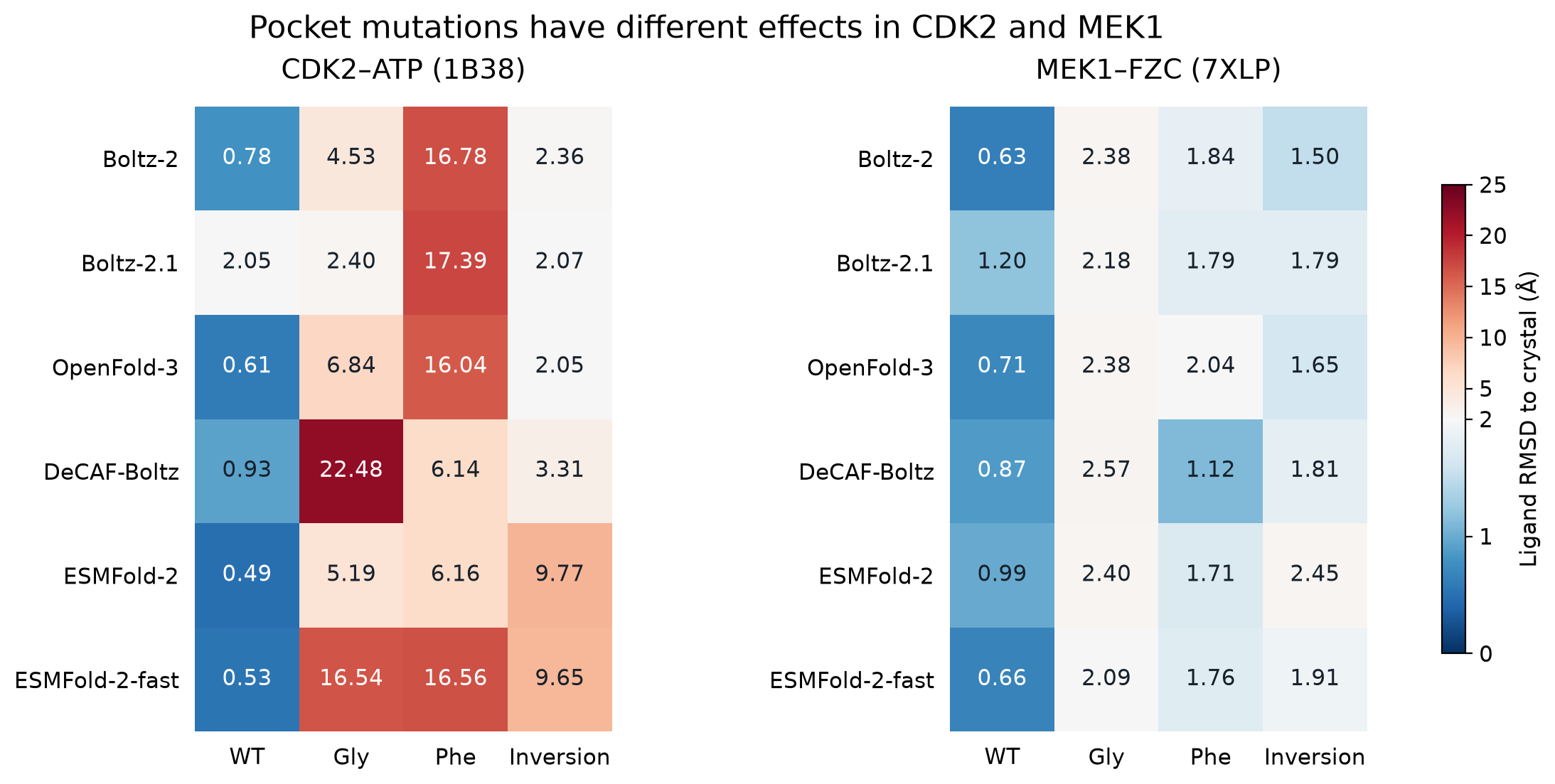
Figure 1. Ligand RMSD to the crystal pose (Å) for each model's highest-confidence prediction. Blue cells are below the paper's 2 Å cutoff.
All six models reproduce both wild-type complexes closely, with RMSDs of 0.5–1.2 Å; the one near-miss is Boltz-2.1 on CDK2, at 2.05 Å. After mutation, the two kinases go in very different directions.
In MEK1, the ligand barely moves. Across all mutant predictions, the ligand stays within 2.6 Å of its crystal pose, despite extensive changes to the pocket residues. Most models remain below the paper's 2 Å cutoff for the phenylalanine and inversion mutants; glycine pushes every model just beyond it. This lines up with the persistent MEK1 poses described in the paper.
CDK2 is a different story. Packing the pocket with phenylalanine displaces ATP substantially in every model (up to 17 Å). Glycine mutations produce more variable movement. The inversion mutant reveals the clearest split: Boltz-2, Boltz-2.1, and OpenFold-3 keep ATP near its original position, while both ESMFold-2 variants move it nearly 10 Å.
That's a lot more movement than the paper reported for CDK2. There, all four models (AlphaFold3, RoseTTAFold All-Atom, Chai-1, and Boltz-1) kept ATP in its original binding mode after the glycine mutation, even though the positively charged residues that anchor the triphosphate were gone. With phenylalanine, some models shifted the ligand, but it stayed biased toward the ATP pocket, and Chai-1 and RoseTTAFold All-Atom left it entirely inside, with steric clashes in several structures. After inversion, all four kept ATP in the original site without much change in pose.
It's tempting to read this as these newer models being "more physical," but we'd be careful. Co-folding predictions depend on inference settings, including recycling rounds, diffusion steps, template use, physics-based steering, and the number of samples generated. We selected the highest-confidence prediction from five samples, matching the paper's AlphaFold3 protocol, while its Boltz-1 results used only one sample. A ligand leaving a blocked pocket also doesn't establish that its new pose is correct. These tests show whether a prediction responds to changed pocket chemistry, not whether the resulting complex is physically plausible or whether the ligand still binds.
Scaling Up to CASF-2016
The paper also ran the same mutations across CASF-2016, a benchmark of 285 protein–ligand complexes, using AlphaFold3. We repeated this with ESMFold-2-fast.
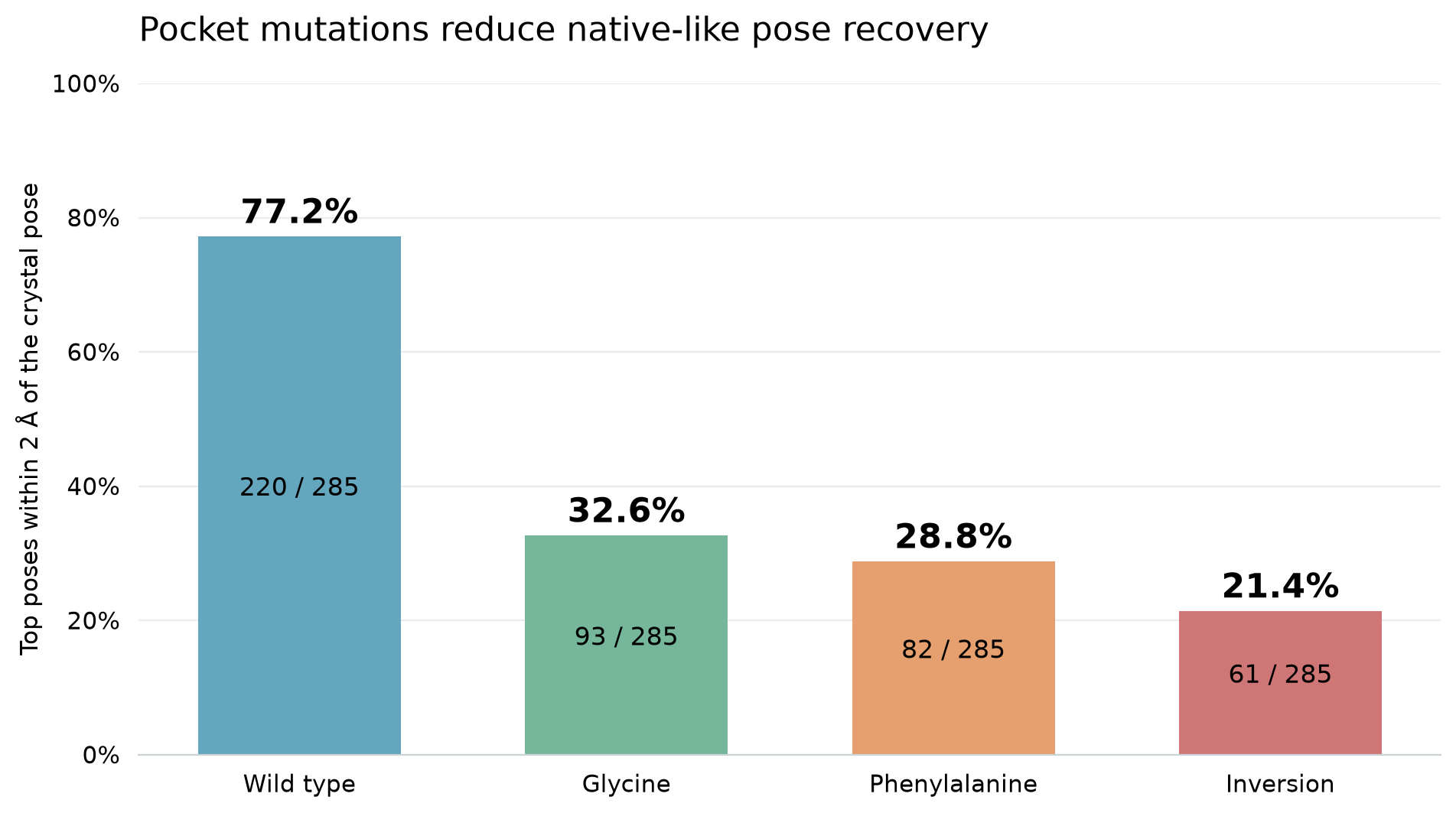
Figure 2. Fraction of top-ranked ESMFold-2-fast predictions within 2 Å of the crystal pose.
Across the full benchmark, the mutations clearly matter. 77% of wild-type predictions are native-like, falling to 33% for glycine, 29% for phenylalanine, and 21% for inversion.
The model's confidence drops too. 209 of the 285 wild-type predictions have a mean ligand pLDDT above 80; after mutation, only 69, 44, and 44 do.
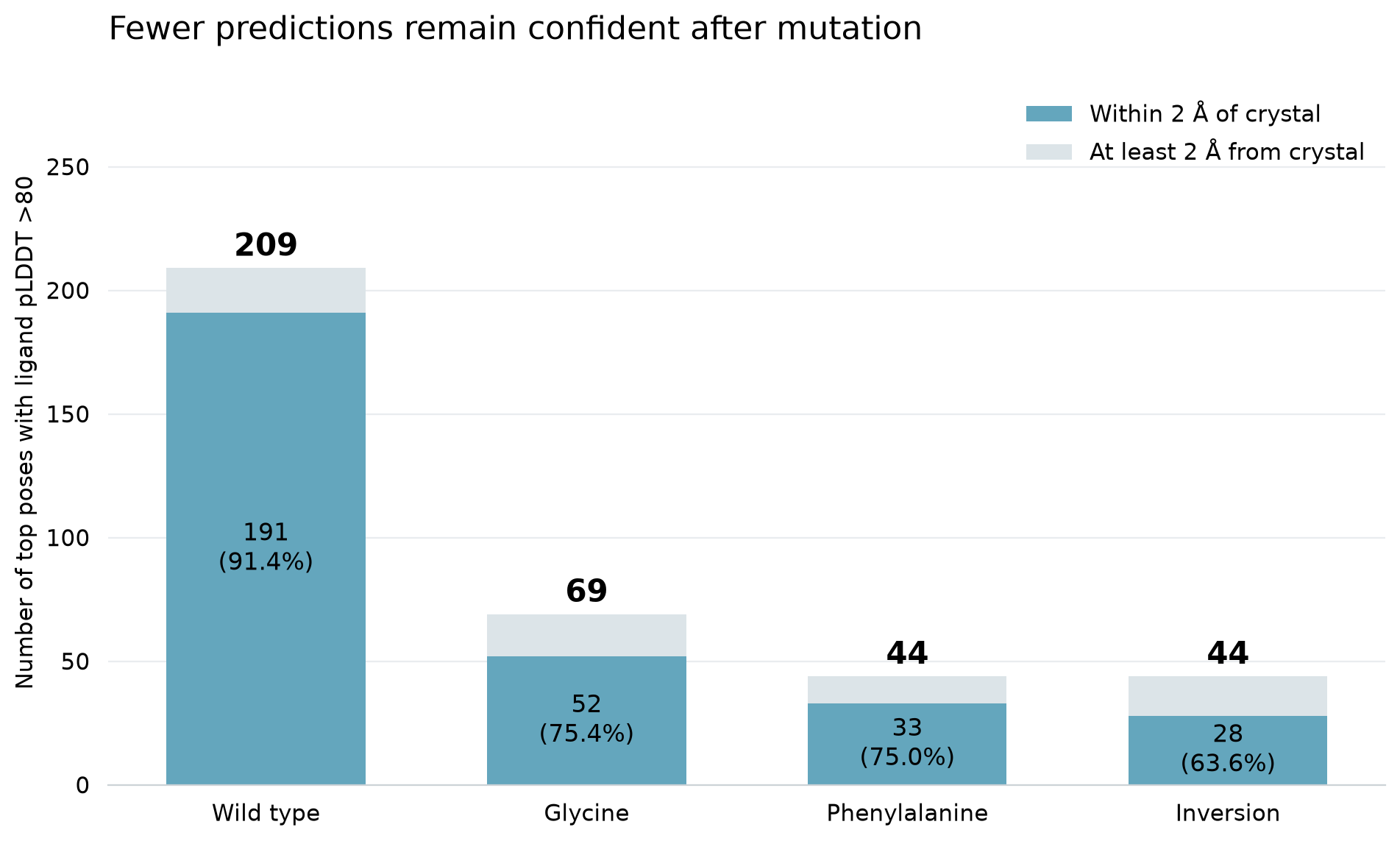
Figure 3. Number of top-ranked predictions with mean ligand pLDDT above 80. The blue portion of each bar is native-like.
That's the behavior you'd hope for: most of the time, the model either moves the ligand or tells you it's less sure. The confident mutant predictions are still worth a second look, though. Between 64% and 75% of them are native-like, meaning the model is confidently placing the ligand in its original pose inside a pocket that has been substantially rewritten.
How Does Confidence Compare with AlphaFold3?
The paper's Figure 3 slices the data a different way: within each ligand-confidence range, what fraction of predictions keep the native pose? Here's that view for AlphaFold3 and ESMFold-2-fast side by side.
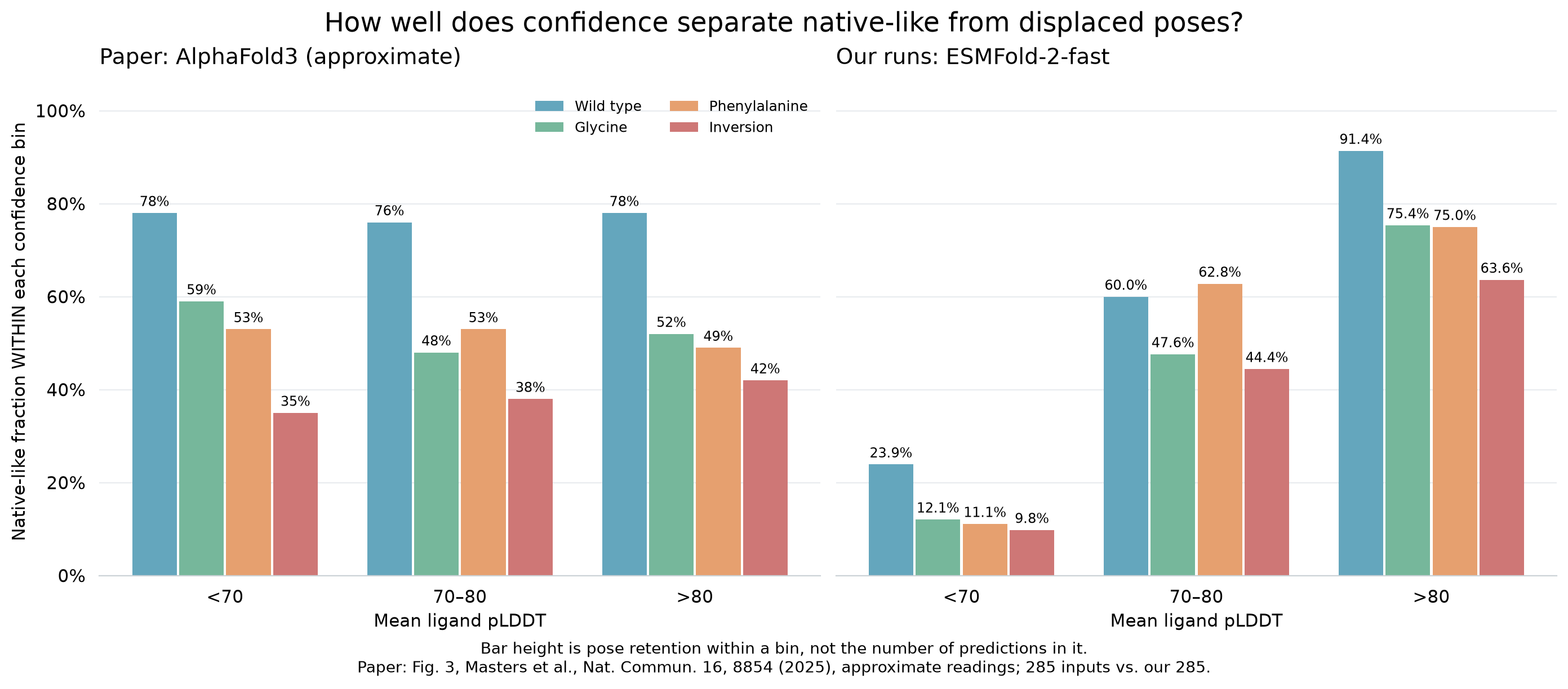
Figure 4. Native-pose retention within each ligand-pLDDT range. Left: approximate readings from the paper's Figure 3. Right: our ESMFold-2-fast results. Models and settings differ.
For ESMFold-2-fast, confidence tracks pose retention closely. Across the four conditions, predictions with ligand pLDDT above 80 are native-like 64–91% of the time, compared with 10–24% for predictions below 70. AlphaFold3's bars are much flatter: in the paper's figure, wild-type retention is around 78% whether pLDDT is below 70 or above 80.
So in our runs, low ligand pLDDT is a useful warning that a pose has drifted from the crystal structure. That's still a statement about the pose, not about binding; pLDDT isn't a binding probability.
Final Thoughts
Co-folding is very accurate when it comes to reproducing known complexes. Every model reproduced both wild-type kinase complexes closely, and ESMFold-2-fast placed 77% of CASF-2016 ligands within 2 Å of the crystal pose. The mutation tests ask a different question: once the pocket is destroyed, does the native pose go away? It should, and usually it does. Native-like poses fall to 21–33% across CASF. But in a meaningful fraction of cases the ligand stays put anyway, and for MEK1 it stays put in almost every model. That means a correct wild-type pose doesn't by itself show that the model got there from the pocket's interactions. Some of that accuracy likely comes from recognizing a familiar protein and ligand.
What does co-folding get right? It's fast, produces physically plausible complexes, and in aggregate it does respond to the pocket: most of the time, rewriting the binding site either moves the ligand or lowers the model's confidence. For ESMFold-2-fast, that confidence is genuinely informative. A ligand pLDDT below 70 was a reliable sign that the pose had drifted, which makes confidence a useful first-pass filter.
Three things stood out about where co-folding falls short. First, behavior is system-dependent: the same models that react strongly to CDK2 mutations barely notice MEK1's, and nothing in the wild-type predictions warns you which kind of system you have. Second, models disagree, as they did on the CDK2 inversion mutant, and there's no way to tell from the outputs alone which one is right. Third, high confidence isn't a guarantee: 64–75% of confident mutant predictions kept the original pose in a pocket that no longer supports it. And even when a model does respond, a ligand that leaves a blocked pocket hasn't necessarily landed somewhere correct. None of these outputs say whether the ligand actually binds.
We think co-folding is best used as a fast hypothesis generator whose reliability falls off as you move away from its training data. We recommend trusting it most for known targets with familiar ligands, and being more skeptical with mutants, unusual pockets, or new scaffolds. We think the following practices can help:
- Sample and compare. Look at several samples and several models. Agreement is reassuring (though models trained on similar data can share blind spots); disagreement is a clear signal to dig deeper.
- Use confidence as a filter, not a verdict. Low ligand confidence is a good reason to discard a pose; high confidence is a reason to keep checking, not to stop.
- Follow up with physics. PoseBusters for geometry and clashes; relaxation plus interaction-energy or affinity scoring to see whether the contacts look favorable; molecular dynamics to see how the pocket and ligand behave in solvent (though staying put in a short simulation doesn't prove binding); and free-energy perturbation (FEP) when affinity is the real question. FEP explicitly models the protein, ligand, and solvent, so it can test whether a predicted pose actually holds up and rank related ligands, though its results are only as good as the starting pose. For larger pocket changes, binding/unbinding methods like those in the paper are a better fit.
If you want to run co-folding, MD, or binding-affinity calculations on your own systems, try Rowan out!