Modeling Selectivity with Low-Cost Binding-Affinity Methods
by Ari Wagen · Oct 28, 2026
I did the modeling for this post during our recent company-wide retreat in the Finger Lakes. We'll be sharing more from the retreat in the coming days.
There's always a lot of buzz in computational chemistry about binding-affinity prediction. For a target-based drug discovery program, on-target binding is a non-negotiable. Protein–ligand binding is also computationally tractable, so computational scientists have developed an abundance of methods to model it, ranging from simple QSAR models to compute-intensive approaches like free-energy perturbation (FEP). We've previously written about the range of binding-affinity predictors.
We've been paying particular attention to low-cost methods since launching our binding-affinity prediction workflow. We recently tested these methods on the Wang et al. 2015 JACS FEP benchmark, finding fair predictive accuracy.
I wanted to explore whether these low-cost methods could also predict trends in selectivity between two targets. Binding-affinity predictors are often evaluated on hit-finding or lead-optimization benchmarks. But if they capture the underlying physics accurately enough, they should also be able to predict differences in potency between targets in the same protein family.
Data
In a recent JMC paper, Yue et al. from Shenyang Pharmaceutical University and SunShine Innovation Co. in China reported a campaign to design selective, noncovalent JAK1 inhibitors. The paper reports IC50 values against both JAK1 and JAK2 for a series of 29 compounds, providing experimental potency and selectivity data to compare our predictions against. A few example compounds are shown below:
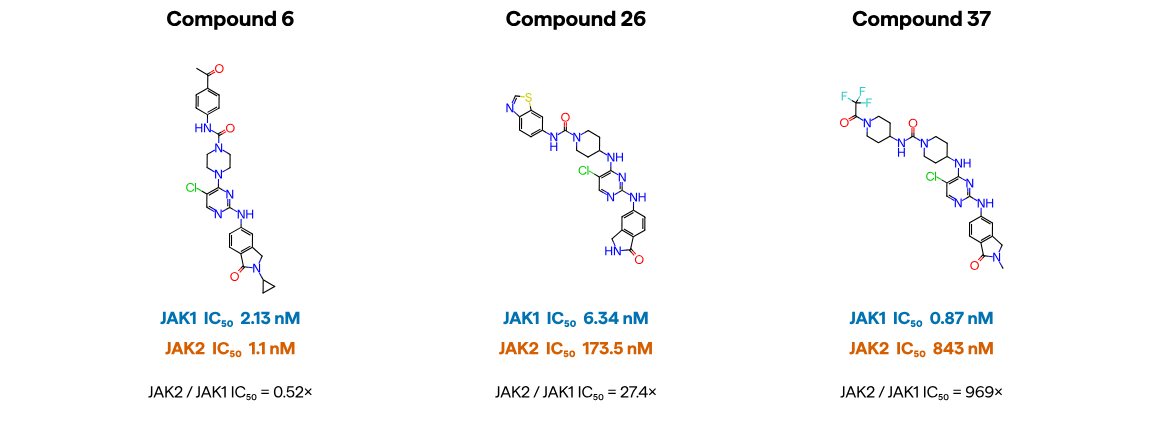
Selectivity is expressed as the ratio of JAK2 IC50 to JAK1 IC50. Ratios greater than 1 indicate a preference for JAK1, with compound 37 showing particularly high selectivity.
Methods
I modeled these compounds using several approaches:
- AutoDock Vina with Vinardo scoring
- Gnina
- Boltz-2
- Nesso-1
- UMA-S-1.2 single-point energies, optionally following ligand optimization with the protein held fixed. The protein was truncated to include only residues within 6 Å of any ligand atom, and no implicit solvent was used. The poses were taken from Gnina.
The paper was published in February 2026, well after the Boltz-2 training cutoff. However, Nesso-1 may have included these compounds in its training data.
Results
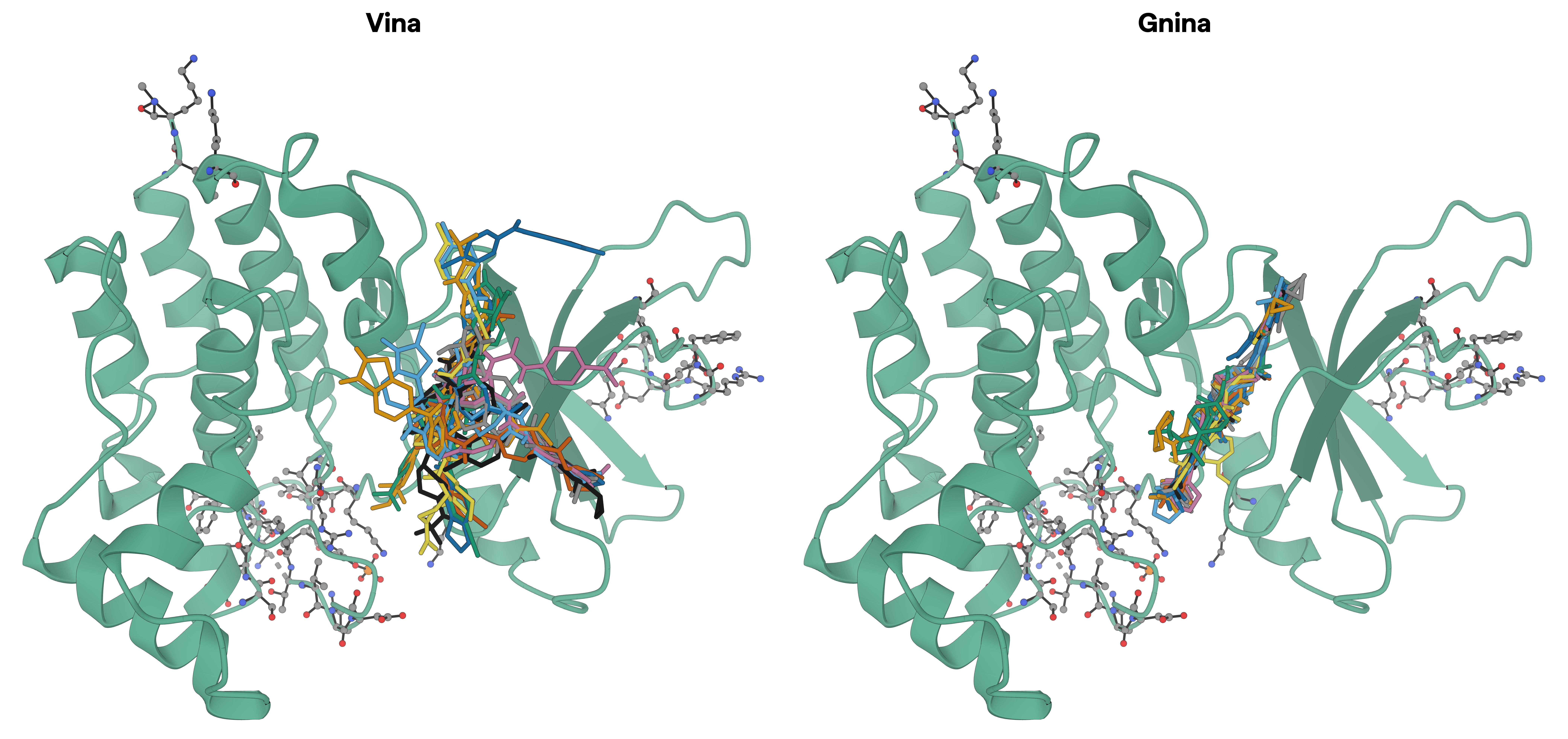
Both AutoDock Vina and Gnina were run with an exhaustiveness of 16, but Gnina produced more closely overlapping poses. I used the Gnina poses as starting structures for the UMA binding-affinity calculations.
The table below shows Spearman correlations (ρ) across 29 compounds. The JAK1 and JAK2 columns compare predicted scores, oriented so higher values indicate stronger binding, with experimental pIC50 values. The selectivity column compares the difference in predicted scores between JAK1 and JAK2 with log10[IC50(JAK2)/IC50(JAK1)].
| Method | JAK1 Spearman ρ | JAK2 Spearman ρ | Selectivity Spearman ρ |
|---|---|---|---|
| Vinardo | −0.20 | +0.05 | +0.42 |
| MM/GBSA on Vinardo | +0.37 | +0.12 | +0.18 |
| Gnina CNN affinity | −0.14 | −0.21 | −0.19 |
| MM/GBSA on Gnina | +0.06 | +0.38 | +0.03 |
| Boltz-2 | −0.01 | −0.36 | −0.06 |
| Nesso-1 | +0.02 | −0.40 | −0.02 |
| UMA SP | +0.05 | +0.15 | −0.10 |
| UMA opt → SP | −0.02 | +0.14 | −0.06 |
No method consistently reproduces the experimental rankings across JAK1 potency, JAK2 potency, and selectivity. Vinardo gives the strongest selectivity correlation (ρ = 0.42), despite correlating poorly with potency against either target individually.
Overall, these correlations are much weaker than those we observed on the JACS FEP binding-affinity benchmark. There are several possible explanations worth investigating:
- Differences in assay conditions, experimental noise, or the range of measured potencies could make this dataset harder to model.
- Exposure to the JACS benchmark—through training data for learned models or its repeated use in method development—could contribute to stronger performance on that dataset.
- Error cancellation in the UMA calculations may depend strongly on consistent poses and alignment across the compound series. For each compound, I used the Gnina pose with the highest CNN score, with and without subsequent ligand optimization. A more controlled alignment or manually selected poses might produce different results.
These are hypotheses, and the current results don't tell us which, if any, explains the difference.
Although these results are disappointing, we think it's important to be honest about where computational methods succeed and where they struggle. Finding those limits helps guide our development, and we hope this encourages others to evaluate selectivity alongside single-target affinity.